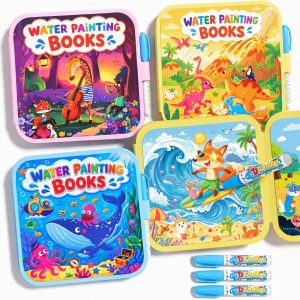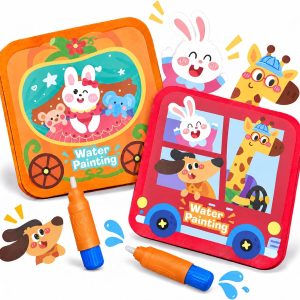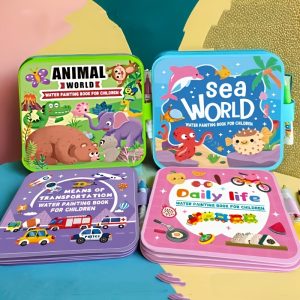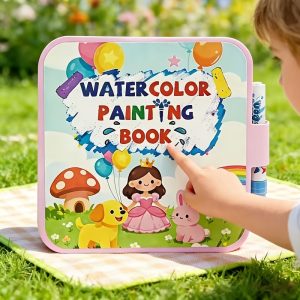

Water painting books can be a convenient, low-mess way for young children to explore colors and drawing. Instead of using a cup of paint, many water-reveal books use a refillable water pen or brush to make colors and pictures appear on the page. The pages then dry and return to their original appearance for another activity.
But using only water does not automatically make a water painting book safe for babies.
The most important thing to check is the product’s recommended age. Many popular water-reveal activity books are designed for children ages 3 and up, rather than infants.
For a baby or child under 3, parents should also consider small or detachable parts, the construction of the water pen or brush, the materials used, and the manufacturer’s safety labeling.
Are Water Painting Books Safe for Babies?
There is no single yes-or-no answer for every water painting book.
A water painting book may reduce some of the concerns associated with traditional children’s painting because the activity can use water instead of an open container of liquid paint. Many products are also designed to be reusable and mess-free.
However, the absence of conventional paint is only one part of product safety.
For babies and children under 3, the product’s intended age and physical construction matter. The U.S. Consumer Product Safety Commission (CPSC) requires special consideration of small parts because they can present choking, aspiration, or ingestion hazards for young children. CPSC also recommends following the age guidance and safety information provided with children’s toys.
So a better rule is:
Choose a water painting book based on its complete safety information, not simply because it uses water.
Why Water Painting Books Can Be Appealing to Young Children
Water painting books have several practical advantages for parents.
Most water-reveal designs allow children to brush or draw with water and see hidden colors or pictures appear. After the pages dry, the images fade or reset so the activity can be repeated.
Compared with conventional painting, this can mean:
- Less mess from spilled paint
- No need to prepare multiple paint colors
- No wet paint to clean from the table after every session
- Reusable activity pages
- Easy storage and transportation
Some products are specifically marketed as travel activities for toddlers and preschoolers.
These features can make water painting books convenient, but they should not be confused with an infant safety certification.
Why Age Recommendations Matter
Age guidance is one of the first things parents should check.
For example, several current! products from Joyzle are listed as 3+ years, including water-reveal activity pads with reusable pages and refillable water pens.
Other water painting books from children’s publishers also commonly target ages 3–5 or 3–7.
That distinction matters because an infant may interact with a product differently from a preschooler. A baby may mouth, chew, pull, or tear an item rather than simply use it as intended.
CPSC guidance specifically recommends choosing toys according to the child’s age, abilities, and the safety information on the packaging.
Therefore, if a water painting book is labeled 3+, it should not be treated as an infant toy simply because the activity itself uses water.
What Should Parents Check Before Giving One to a Baby?
1. Check the Recommended Age
Start with the manufacturer’s age recommendation.
If the product is marked 3+, don’t assume that it is appropriate for a baby or younger toddler. The age recommendation reflects the intended use of the product and can be connected to its design and safety characteristics.
2. Look for Small or Detachable Parts
Small components can create a choking concern for children under 3.
Pay particular attention to:
- Removable accessories
- Loose pieces
- Caps
- Stamps
- Decorative components
- Parts that could break away from the book
- Small attachments on the water pen
CPSC states that products intended for children under 3 that contain or can produce hazardous small parts are subject to specific requirements.
3. Inspect the Water Pen or Brush
The water pen is an important part of many water painting books.
Check whether it is securely constructed and whether the cap, tip, or other components can become detached.
A chunky pen designed for young children’s hands may be easier to hold, but easy to grip does not by itself mean that the pen is appropriate for an infant.
4. Check What “Water Painting” Actually Means
Not every water painting book uses exactly the same technology.
Some reusable water-reveal books use pages that display hidden colors when wet. Others use a paint-with-water format where pre-printed paint dots react when a wet brush passes over them.
That means parents should look at the actual product description and materials rather than assuming every “water painting book” works the same way.
5. Be Careful With “Non-Toxic” Claims
“Non-toxic” can sound reassuring, but it should not be the only safety criterion.
CPSC notes that “non-toxic” is not itself a defined regulatory term in the relevant art-material context. Product-specific safety claims should therefore be supported by the manufacturer’s information and applicable requirements rather than assumed from the wording alone.
For a product intended for young children, look for clear manufacturer information about materials, age range, warnings, and applicable safety requirements.
6. Check the Product Condition
Even an age-appropriate product should be inspected before use.
Do not give a baby a water painting book if:
- The pages are tearing apart
- A binding component is loose
- The water pen is cracked
- A cap or tip has become loose
- Small pieces have broken away
- The product has been damaged through repeated use
A product’s safety can change if it becomes damaged.
Are Water Painting Books Safe for Toddlers?
They can be appropriate for toddlers when the specific product is designed and labeled for that age group.
In fact, many water-reveal activity books are marketed specifically toward toddlers and preschoolers, with features such as reusable pages, chunky water pens, and simple illustrations.
However, “toddler-friendly” does not mean that every water painting book is suitable for every toddler.
A two-year-old and a four-year-old can interact with the same product very differently. Always follow the manufacturer’s age recommendation and inspect the product for loose or detachable parts.
What About a 1-Year-Old?
Extra caution is appropriate for a 1-year-old.
A one-year-old may still explore objects by putting them in their mouth, pulling on them, or chewing them. If a water painting book is labeled 3+, it is not appropriate to override that recommendation simply because the book uses water instead of paint.
If you want to introduce a baby to painting with water, a simpler activity may be more appropriate: for example, supervised water play using a large sheet of paper and water, without small detachable accessories.
The important difference is that the activity should be selected for the child’s developmental stage rather than assuming that a commercial product designed for older children is automatically suitable.
Are Water Painting Books Better Than Traditional Paint for Babies?
They may be less messy, but “less messy” and “safer for babies” are not the same thing.
Water-reveal books can avoid some of the practical issues associated with traditional painting, such as spilled paint and cleanup. Some products also eliminate the need for conventional paint during the activity.
But the overall safety of a children’s product still depends on:
- Intended age
- Physical construction
- Small parts
- Detachable components
- Materials
- Product warnings
- Manufacturer instructions
So the better comparison is not simply:
Water = safe / Paint = unsafe
Instead:
Evaluate the complete product for the child who will use it.
The Bottom Line
Water painting books can be a useful, low-mess creative activity, but they should not automatically be considered baby-safe simply because they use water.
Many popular water-reveal books are actually designed for children 3 years and older, and CPSC guidance emphasizes following age recommendations and paying particular attention to small parts and choking hazards for children under 3.
Before giving a water painting book to a young child, check:
- The recommended age
- Small or detachable parts
- The water pen or brush
- Product materials
- Safety warnings
- Manufacturer safety information
- The condition of the product
For babies, the safest choice is not determined by the words “water painting” alone. The complete product design and its intended age range matter much more.
Frequently Asked Questions
Are water painting books non-toxic?
Not necessarily by default. Different products use different materials and mechanisms. Check the manufacturer’s specific material and safety information rather than assuming that every water painting book is non-toxic. CPSC also cautions that “non-toxic” is not itself a defined regulatory term in the relevant art-material context.
Can babies use water-reveal books?
It depends on the specific product and its age recommendation. Many popular water-reveal books are labeled 3+, so they should not automatically be given to infants.
Are water painting books safe for 2-year-olds?
Only if the particular product is designed and labeled for that age. If the packaging states 3+, it should not be treated as suitable for a 2-year-old simply because it uses water.
Why are many water painting books labeled 3+?
Many products include a water pen, brush, binding components, or other parts that are designed around preschool-age use. CPSC safety requirements also place particular emphasis on small parts and choking hazards for children under 3.
Is a water painting book safer than regular paint?
It can be less messy and may reduce direct exposure to conventional wet paint, depending on the product. But that does not automatically make it safer for babies. Age suitability, construction, materials, and small-part risks still need to be considered.