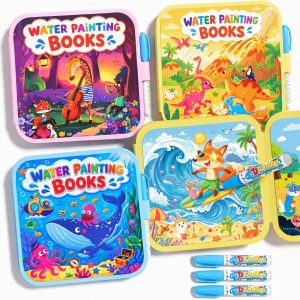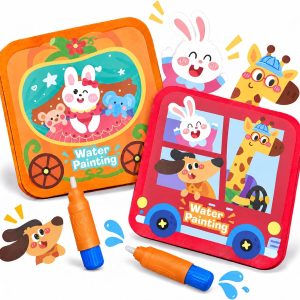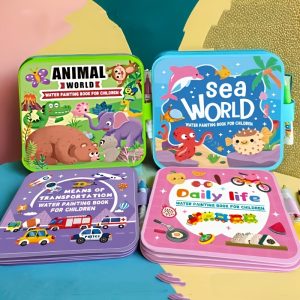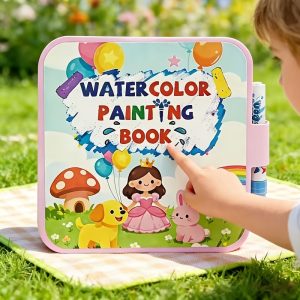

When I compare reusable water painting books with traditional coloring books, I don’t think one is simply better than the other. They give kids two different ways to color.
A reusable water painting book is built around water, color reveal, and repeat use. A traditional coloring book is built around crayons, markers, or colored pencils and artwork that stays on the page.
That difference matters more than the word “coloring.”
If I wanted a simple activity for a young child, a trip, or a situation where I don’t want crayons and markers scattered around, I’d lean toward a reusable water painting book. If I wanted my child to choose colors freely, experiment with shading, or keep the finished artwork, I’d choose a traditional coloring book.
The Main Difference Between Water Painting Books and Coloring Books
A reusable water painting book doesn’t work like an ordinary paper coloring book.
With a typical water-reveal book, the child fills a reusable water pen and brushes it across the page. The wet area reveals colors, pictures, or patterns. Once the page dries, the image disappears and the page can be used again.
A traditional coloring book works in the opposite direction.
The child puts color onto the paper with crayons, colored pencils, or markers. The color stays there, so the finished page becomes part of the child’s artwork. Crayola’s conventional coloring books are designed specifically to work with crayons, markers, or colored pencils, and some contain dozens or hundreds of pages.
So I see the basic difference this way:
Water painting book: color – dry – reset – color again
Traditional coloring book: color – finish – keep the artwork
That is the trade-off that is often missing from simple product comparisons.
How Do Reusable Water Painting Books Work?
The idea is surprisingly simple.
The book contains pages or boards that respond to water. Instead of giving a child a box of crayons or markers, the activity usually comes with a refillable water pen.
The child fills the pen with water and uses it on the page. The colors or hidden artwork become visible as the page gets wet. After the water evaporates and the page dries, the artwork fades again.
joyzle pages as white when dry and designed to reveal colors, pictures, and shapes when wet. The same product line uses a chunky refillable water pen that stores with the book, which is one reason the format works well as a portable activity.
What I like about this format
The child gets the satisfying part of coloring without needing a complete set of art supplies.
There is no need to decide which crayon to use first. There is no marker cap to lose. And when the activity is over, the page can simply dry.
But there is an important limitation: the child isn’t creating a permanent colored picture in the same way they would with crayons.
The disappearing color is both the main feature and the main limitation of a reusable water painting book.
Water Painting Books vs. Coloring Books: Side-by-Side
| Feature | Reusable Water Painting Book | Traditional Coloring Book |
|---|---|---|
| Reusable pages | Yes | No, generally |
| Coloring tool | Water pen | Crayons, markers, colored pencils |
| Cleanup | Very low | Depends on supplies |
| Artwork stays permanently | No | Yes |
| Color choice | Usually limited by page design | Very flexible |
| Blending and shading | Limited | Much more flexible |
| Travel | Excellent | Good, but needs coloring supplies |
| Repeated practice | Excellent | Requires new pages |
| Creative freedom | Moderate | High |
| Best for | Simple, repeatable activities | Open-ended coloring |
This doesn’t mean a traditional coloring book is difficult or messy. Many are simple travel activities too. Crayola, for example, sells compact coloring sets specifically for travel and pairs traditional coloring pages with crayons or other coloring supplies.
The difference is that a traditional coloring activity requires the child to manage an actual coloring medium, while a water book is designed around a single reusable water tool.
Which Is Better for Toddlers?
For a child who is just getting comfortable with coloring, I’d consider a reusable water painting book when simplicity is more important than artistic freedom.
The child doesn’t have to choose between a dozen crayons. The basic action is simply:
fill the pen – paint with water – watch the picture appear.
Many water-reveal products are marketed specifically toward preschool-aged children. Joyzle, for example, is listed for ages 3–6 and combines reusable coloring boards with a refillable water pen.
A traditional coloring book can still be an excellent choice at this age, especially when the child is ready to practice controlling crayons or colored pencils.
So I wouldn’t make the decision based only on age.
I’d ask a more useful question:
Does the child need a simple activity, or is the goal to practice choosing and applying colors?
For the first, I’d lean toward water painting.
For the second, I’d lean toward traditional coloring.
Which Is Better for Travel?
This is where reusable water painting books have a very practical advantage.
If I’m packing an activity for an airplane, car ride, restaurant, or waiting room, I would rather carry a reusable water book and one water pen than a coloring book plus several crayons or markers.
The compact format also makes repeated use useful during longer trips. A child can color a page, put it aside while it dries, and return to it later.
Traditional coloring books can absolutely work for travel, especially because many children’s coloring books are already designed for road trips and other portable activities.
The difference is mainly how much equipment you want to carry and manage.
Which Gives Kids More Creative Freedom?
Here, I’d give the advantage to the traditional coloring book.
This is one of the biggest differences that isn’t obvious from the phrase “water coloring book.”
With crayons or colored pencils, a child can decide:
- which colors to use
- where to put them
- whether to stay inside the lines
- whether to mix colors
- whether to shade
- whether to make unusual color combinations
A reusable water painting book usually has a more controlled visual outcome. The page itself determines much of what appears when the water is applied.
That makes it easier to use, but it also makes the activity less open-ended.
Crayola’s traditional coloring products, for example, explicitly emphasize letting children choose colors and use crayons, markers, or colored pencils to create their own results.
So if my priority were creative control, I’d choose a traditional coloring book.
If my priority were easy repeatable play, I’d choose the water painting book.
What About Keeping the Finished Artwork?
This is another clear difference.
A traditional coloring page can become something a child keeps.
They can put it on the refrigerator, give it to a grandparent, put it into a folder, or simply look back at it later.
A reusable water painting book is not designed around that experience.
Once the water dries, the colors disappear.
That’s fantastic if I want the child to have another blank activity page without buying another book.
But it isn’t ideal if the goal is to create a permanent collection of artwork.
So I would think about the purpose before buying:
Want something to keep?
Choose a traditional coloring book.
Want something to do again?
Choose a reusable water painting book.
Are Water Painting Books Really More Convenient?
For certain situations, yes.
The biggest convenience comes from the coloring medium.
Traditional coloring usually means managing crayons, colored pencils, markers, or similar supplies. Conventional children’s coloring books are commonly sold specifically with these tools or designed to be paired with them.
A water painting book replaces those supplies with water.
That makes cleanup much simpler in normal use.
But I wouldn’t interpret “mess-free” as “nothing can ever get wet.”
The book still uses water, and individual products can have care restrictions. For example, some reusable water-painting products specifically warn users not to immerse the entire book in water.
So the better description is:
Low-mess rather than completely maintenance-free.
You still need to let the pages dry and take reasonable care of the book.
What About Mess-Free Coloring Books?
There is another option that is easy to confuse with water painting books: mess-free marker systems.
Crayola Color Wonder is a good example.
Color Wonder uses specially formulated paper and compatible markers, paints, or stamps. The colors appear on the special paper but not on skin, clothing, or furniture.
But it has one important difference from reusable water painting books:
Color Wonder paper is not reusable.
Crayola explicitly says that the same piece of Color Wonder paper cannot be reused twice.
So I would separate the three options like this:
Reusable water painting book
Water + reusable page
Traditional coloring book
Crayon/marker/pencil + permanent artwork
Color Wonder
Special paper + mess-free ink + permanent artwork
Which One Is Better for Repeated Practice?
I’d choose the reusable water painting book.
That’s really where the format makes the most sense.
A child can return to the same pages without consuming another sheet of paper every time. The page essentially resets after drying.
This can be useful when a child enjoys repetition.
Instead of finishing one picture and moving on to another page, the child can repeat the same activity.
I would not attach a universal number such as “100 uses,” though. Different products use different materials and construction, and the exact lifespan depends on the product.
That distinction makes the purchasing decision much clearer.
Which One Should You Buy?
If I’m choosing between the two, I would make the decision based on how the child will actually use it, rather than which product sounds more advanced.
Choose a reusable water painting book if:
you want minimal cleanup
the child enjoys repeating the same activity
you’re looking for a travel activity
you don’t want to carry crayons or markers
the child is still developing basic coloring control
you want an activity that resets after drying
you want a simple screen-free activity
Choose a traditional coloring book if:
the child enjoys choosing colors
creative freedom is important
you want permanent artwork
the child likes crayons or colored pencils
you want to practice blending or shading
you want the child to experiment with different colors
you want a large number of conventional coloring pages
Can a Reusable Water Painting Book Replace a Coloring Book?
Not completely.
I wouldn’t buy a reusable water painting book expecting it to replace every purpose of a traditional coloring book.
It replaces some of the activity, but not all of the creative experience.
A water painting book is especially good at making coloring:
- repeatable
- portable
- simple
- low-mess
A traditional coloring book is better when the goal is:
- permanent artwork
- color selection
- experimentation
- shading
- blending
- open-ended creativity
That’s why I see them less as competitors and more as two different tools.
If I were building a small activity collection for a young child, I’d actually consider having both.
A reusable water painting book would be the one I’d grab for a restaurant, airplane, car ride, or quick activity.
A traditional coloring book would be the one I’d use when we actually want to sit down and create something that stays on the page.
My bottom line
For convenience and repeat use: reusable water painting books win.
For creative freedom and permanent artwork: traditional coloring books win.
And if the main reason you’re considering a water painting book is simply that you want a cleaner, easier coloring activity for a young child, that’s probably where the format makes the most sense.